
First-Time Home Buyer Programs in Florida (Orlando & Kissimmee)

If you’re thinking about buying your first home in Orlando or Kissimmee, you may be surprised by how many first-time home buyer programs are available in Florida. The key is knowing which programs actually help — and which ones sound good but don’t move the needle.

This guide breaks down the most common and useful first-time buyer programs and financing options so you can decide what works best for your situation.

If you want help matching the right program to your budget and credit, start here:

home


What Is Considered a First-Time Home Buyer?

In Florida, you’re typically considered a first-time home buyer if:

  • You’ve never owned a home, or
  • You haven’t owned a home in the last three years

Many buyers qualify even if they owned a home years ago.

FHA Loans for First-Time Buyers

FHA loans are one of the most popular options for first-time buyers in Central Florida.

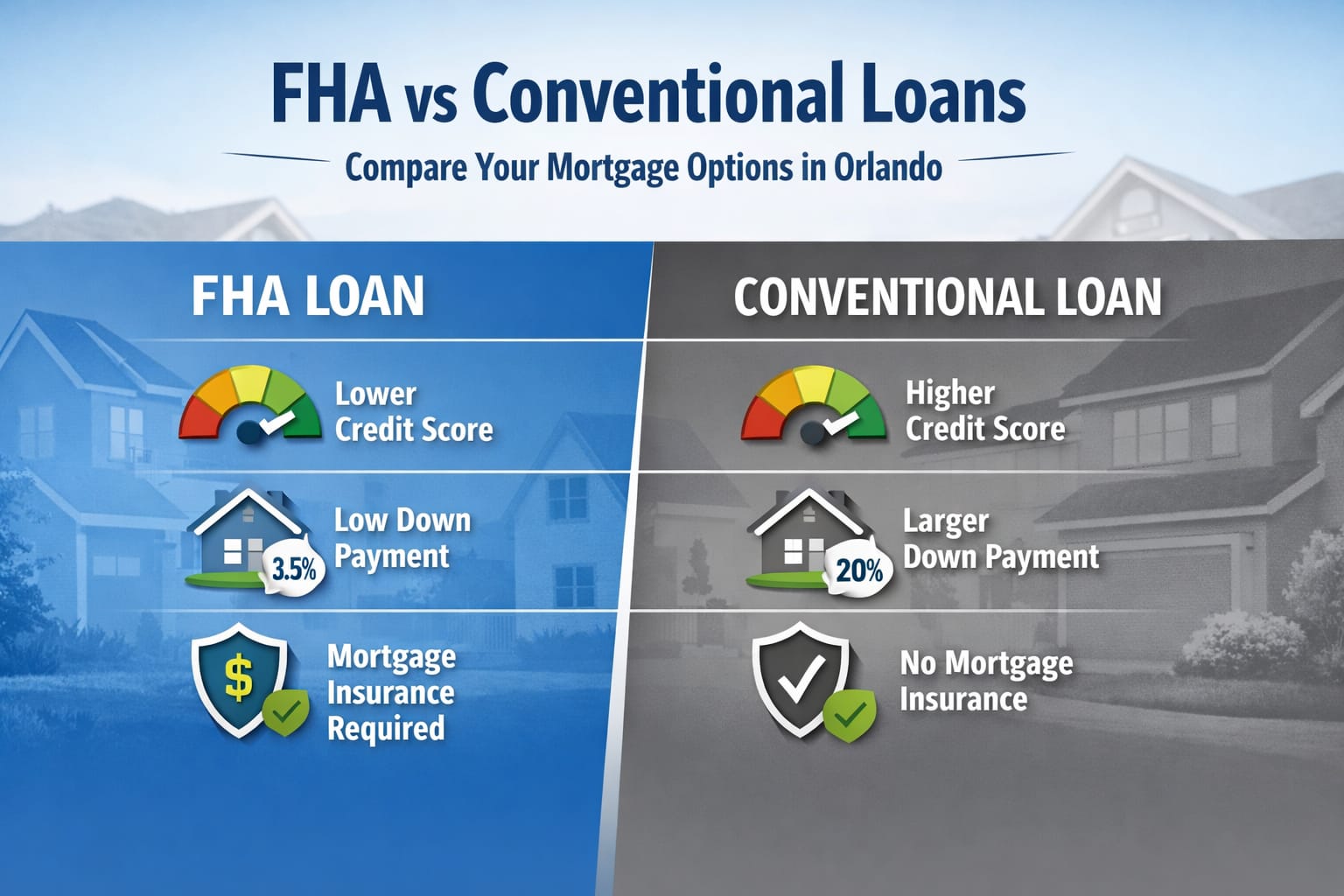
  • Down payments as low as 3.5%
  • More flexible credit requirements
  • Allows higher debt-to-income ratios in many cases

FHA works well for buyers rebuilding credit or buying sooner rather than later.

Conventional First-Time Buyer Programs

Many buyers don’t realize that conventional loans can also work for first-time buyers.

  • Down payments as low as 3% for qualified buyers
  • Lower mortgage insurance costs with strong credit
  • Mortgage insurance can be removed later

For a side-by-side comparison, see: FHA vs conventional loans in Orlando

Florida Down Payment Assistance Programs

Florida offers several statewide down payment assistance options depending on income, location, and loan type.

  • Deferred second mortgages
  • Forgivable assistance programs
  • Low-interest assistance loans

Availability and requirements can change, so lender guidance is critical.

Orlando & Kissimmee Local Buyer Programs

Some city and county programs offer additional assistance for qualifying buyers in Orlando and Kissimmee.

  • Income limits may apply
  • Homebuyer education courses may be required
  • Funds can be limited and competitive

These programs can help, but they are not instant approvals — timing and preparation matter.

Credit Score Requirements

Each program has different credit expectations:

  • FHA programs may allow lower scores
  • Conventional programs usually require stronger credit
  • Down payment assistance programs often have overlays

For exact numbers, see: what credit score you need to buy a house in Orlando

How to Qualify for First-Time Buyer Programs

To improve your chances:

  • Get pre-approved early
  • Improve credit and reduce balances
  • Complete any required homebuyer education
  • Work with a Realtor who understands local programs

If you’re at the beginning of the process, start here: steps to buying a house for the first time

If credit is your biggest hurdle, this guide helps: how to build credit to buy a house


FAQs About First-Time Home Buyer Programs

Do first-time buyer programs really help?

Yes — when used correctly. They can reduce upfront costs, but they don’t replace good credit and solid planning.

Can I use multiple programs together?

Sometimes. Certain loans allow stacking assistance, but rules vary by lender and program.

Are these programs only for low-income buyers?

No. Many programs are income-based, but others are available to moderate-income buyers as well.

Want help choosing the right program? I’ll walk you through your options:

home
Let's Keep In Touch!

New ORC Form Lead

"*" indicates required fields

This field is for validation purposes and should be left unchanged.
TOC*

FHA vs Conventional Loans in Orlando: Which Is Better for First-Time Buyers?

Let's Keep In Touch!

New ORC Form Lead

"*" indicates required fields

This field is for validation purposes and should be left unchanged.
TOC*

The Importance of Homeowner’s Insurance!

Homeowner’s insurance is the most important protection for your most valuable asset – your home.

However, the cost of homeowner’s insurance can be a significant expense for many homeowners. The cost varies depending on several factors, such as the value of your home, your location, and your insurance history.

Location

One of the most significant factors that can impact the cost of homeowner’s insurance is the location of your home. If you live in an area that is prone to natural disasters, such as hurricanes or floods, your insurance rates may be higher. This is because the risk of damage to your home is higher in these areas, which means the insurance company is taking on a greater risk by insuring your property.

Flood insurance is an important protection for homeowners in areas that are at risk of flooding. Homeowner’s insurance typically does not cover flood damage, which means you need to purchase a separate flood insurance policy if you want this coverage.

Flood insurance can be purchased through the National Flood Insurance Program (NFIP) or through private insurance companies. The cost of flood insurance can vary depending on the risk of flooding in your area, the value of your home, and other factors.

If you live in a flood-prone area, it is important to consider purchasing flood insurance to protect your home and belongings. You can access this information on the FEMA flood map.

Age

Another factor that can impact the cost of homeowners insurance is the age and condition of your home. If your home is older or has not been well-maintained, the insurance company may consider it a higher risk and charge you a higher premium. Similarly, if your home has certain features that make it more susceptible to damage, such as a swimming pool or a wood-burning stove, your rates may be higher.

History

Your insurance history can also impact the cost of your homeowner’s insurance. If you have a history of filing claims, insurance companies may view you as a higher risk and charge you higher premiums. Similarly, if you have a poor credit score, insurance companies may consider you a higher risk and charge you more for coverage.

While the cost of homeowners insurance can be a significant expense, it is important to have this protection for your home. Without insurance, you could be at risk of losing everything in the event of a disaster or accident.

To keep your rates as low as possible, consider taking steps to reduce your risk, such as installing a security system or doing home repairs. You can also shop around for insurance quotes to find the best rate for your needs.

Fraudulent Claims

Many of my clients express frustration with the high rates and wonder why they are so much higher than in other states. The truth is, that one of the major reasons for the high rates in FL is excessive fraudulent claims.

Fraudulent claims have been a significant issue in Florida for years, particularly when it comes to property insurance claims. According to the National Insurance Crime Bureau, Florida consistently ranks as one of the top states for insurance fraud. This type of fraud can take many forms, from staged accidents to falsified damage claims.

Fraudulent claims not only drive up the cost of insurance but also have other negative effects on the real estate market. For example, insurance companies may be hesitant to provide coverage in areas known for fraud, making it more difficult to sell homes in those areas.

Natural Disasters

One of the primary reasons that Florida is particularly susceptible to insurance fraud is the prevalence of natural disasters like hurricanes. When a hurricane hits, it can cause widespread damage to homes and businesses, making it easy for dishonest individuals to submit false claims. This type of fraud can drive up the cost of insurance for everyone in the state, even those who have never filed a claim.

In addition to natural disasters, there are other factors that make Florida a target for insurance fraud. For example, the state has a large population of seniors, who are often targeted by unscrupulous individuals looking to take advantage of their vulnerability. There are also many people in Florida who are struggling financially, and some may be tempted to file fraudulent claims to collect insurance money.

Additionally, some insurers may require higher deductibles or refuse to cover certain types of damage altogether, which can make it harder for homeowners to recover from disasters.

Solution

So, what can be done to address the issue of fraudulent claims in Florida? One approach is increasing penalties for those caught committing insurance fraud. The state already has strong laws in place to address insurance fraud, but enforcement can be challenging. By increasing the penalties for those who are caught, it may be possible to deter some would-be fraudsters.

Another approach is to educate homeowners about the dangers of insurance fraud and how to avoid it. Many people may not realize that filing a false insurance claim is a serious crime that can have significant consequences. By raising awareness about the issue, we may be able to prevent some instances of fraud from occurring in the first place.

Insurance companies can also take steps to address the issue of fraud. For example, they can invest in technology that can help detect fraudulent claims more quickly and accurately. They can also work with law enforcement agencies to identify and prosecute those who are committing fraud.

As a Real Estate Broker, I believe it is important to educate my clients about the issue of insurance fraud and how it can impact the cost of homeowner’s insurance in Florida. I also believe it is important to work with reputable insurers who have a strong track record of combating fraud.

In conclusion, by working together, we can help protect homeowners and keep insurance rates as affordable as possible.

Let's Keep In Touch!

New ORC Form Lead

"*" indicates required fields

This field is for validation purposes and should be left unchanged.
TOC*

Will Short Sales Return in 2023?

The real estate market has changed in the past few years, and it is not clear what will happen next year. But experts are offering their evaluations and predictions on where mortgage rates, home prices, buyer competition, housing supply, and sales activity will be headed in 2023.

One of the predictions is Short Sales. These are a type of sale in which the seller owes more on the property than it is worth. This happens when a homeowner is unable to keep up with the mortgage payments or falls behind and the lender agrees to accept less than what is owed in order to release the lien.

Price declines

Despite elevated mortgage rates and sluggish home sales, Lawrence Yun, the National Association of Realtors chief economist, doesn’t expect price declines in 2023. He says prices will continue to be driven by borrowers who have positive equity in their homes.

However, affordability will remain a challenge in markets where price increases have been particularly steep, according to Yun. These include places like Los Angeles, where the median home price is 11 times the average household income, and San Jose, California, where the median home price is 10 times the average household income.

As homebuyers who have been on the sidelines in recent years look to return, competition will keep price declines from ramping up, Steinberg said. Inventory also isn’t likely to increase much because fewer homeowners are willing to sell, he says.

Supply shortages

The housing market will continue to struggle with supply shortages in 2023. As a result, homebuyers will be forced to wait longer to find an affordable property to buy.

This could lead to higher mortgage rates and fewer homes for sale, according to Sharga. Inventory will also be strained in some markets, particularly high-growth areas like Austin, Phoenix, and Boise.

Some of these factors, including increased interest rates and a shortage of available homes, will push prices. That’s bad news for would-be buyers, but it’s also good news for sellers and real estate agents.

Buyer competition

The number of short sales is on the rise. The latest stats from the Mortgage Bankers Association suggest that the number of short sale filings was up by 37% in 2022 compared to 2021. The slew of short sales also prompted a hefty increase in the number of distressed property listings as well. In addition, lenders are putting their hats into the ring by offering more incentive packages to buyers in an effort to close the books on these short sales.

Despite the uptick in distressed home sales, the housing market may still be a bit of a slow burner. With the right mix of inventory and consumer confidence, we should be seeing a more normal housing market in 2023. The frenzied flurry of activity from first-time buyers to retirees should ease as more people buy and sell their homes, allowing for a more balanced market. However, with a still-slow economy and higher interest rates, the housing bubble of yesteryear may be on its way out.

Mortgage rates

Amid a shortage of homes for sale and soaring interest rates, it’s no surprise that sales have been flat or down year over year. But that doesn’t mean the housing market is set for a crash in 2023.

The mortgage rate environment could change significantly based on a number of factors, including the Federal Reserve’s monetary policy and inflation data. For instance, the Fed is expected to raise its benchmark rate at least once this year.

Orlando Realtor

This is largely due to the central bank’s efforts to fight inflation, which has been running at a high rate for years. In December, the Federal Reserve’s consumer price index slipped to its lowest level in almost two years.

Those changes have sparked speculation that the Federal Reserve may slow its rate hikes in 2023. However, that wouldn’t necessarily help mortgage rates, as the Fed’s monetary policy is largely driven by the economy and inflation data.

Let's Keep In Touch!

New ORC Form Lead

"*" indicates required fields

This field is for validation purposes and should be left unchanged.
TOC*

Is It a Good Time to Shop Around For Homeowner’s Insurance?

If you have not shopped around for your homeowner’s insurance for a while, now may be the time to do so. Many insurers tend to raise their rates at renewal time, usually because of inflation or changes in the value of your home. By re-shopping your policy now, you’ll get a better deal on your premiums in the future. Also, if you’ve made any major purchases or added anything to your house, you’ll want to check to see if you’re still covered. You’ll also want to check your floater coverage to see if it is still necessary.

Before you begin your search for homeowners insurance, take a look at your credit score. A good credit score will lower your premiums. Make sure you pay your bills on time and don’t take on too much debt. You’ll also want to take a look at your policy’s coverage and decide if you need any changes. Once you’ve decided what coverage you need, compare rates from different companies.

You’ll want to compare coverage and prices yourself or work with a broker or competing agent. Homeowner’s insurance quotes should include replacement costs for your personal belongings and dwelling. If your policy only provides replacement costs for a depreciated value, you’ll be out of luck if you need to replace them, and you’ll want to make sure your coverage covers these factors, too.

Homeowner’s insurance quotes are an essential part of home ownership, so make sure you shop around early. Compare quotes from at least three different insurance companies before making a final decision. Compare coverage, deductibles, and customer service from multiple companies. After all, you’ll be staying with your policy for the next year, so you want to make sure it meets your requirements. Also, check with your lender for any clarifications.

You’ll also want to check if the company you choose offers any discounts for multiple policies. If you’re living with someone, be sure to ask the insurance company. Many companies offer discounts if you combine multiple policies with them. You can also bundle multiple policies together for a larger discount. Be sure to compare the total cost of these policies to find the best one for you.

While shopping around for your insurance policy can be time-consuming, it’s a good idea for many consumers. Research shows that more than seventy percent of consumers have saved money by shopping around for their insurance. Shopping around can be done in less than an hour. The best time to do it is between 30 minutes and two hours. Regardless of your budget, it’s worth the time to compare different policies and insurance companies. You’ll be amazed at what a difference it makes.

Getting a homeowner’s insurance quote is easy online and over the phone. Many insurance companies have websites that can help you compare prices. You can even get a free quote over the phone. However, if you have any questions, you should talk to an insurance agent. They’ll know what type of coverage you need and the price you can afford. In addition, independent agents have access to a large number of insurance companies, making it easier to find a great deal. Call your local Orlando Realtor and ask them for help.

What Makes It a Good Homeowner’s Insurance Policy?

There are many things to consider when buying home insurance. First, make sure that you understand your policy fully. Make sure you understand the terms and conditions, especially the one that covers the cost of replacing your belongings. You should also make sure to review your policy on a yearly basis. The main reason for this is that many home insurance companies tend to increase their rates annually because of inflation and increases in the value of homes. Even a small increase can add up over time, so it is always worth considering other options.

Another thing to consider is your location. The type of perils your home is exposed to will affect your premium. If you live in an area that is prone to hurricanes, for example, you will pay a higher premium than if you live in a rural area. The type of house you own will also affect the premium, as will its age and style. If it is an older or deteriorated house, you are more likely to have an expensive claim.

A good homeowner’s insurance policy will cover damage to your personal possessions, even if they are not in your home. It also covers the damage caused by a listed disaster. In addition, it covers any expenses related to identity theft. In addition to a property policy, homeowners can opt for extra coverage like sewer and drain backup coverage. It is also important to consider whether the insurance provider offers identity recovery coverage for people who have been a victim of identity theft.

Let's Keep In Touch!

New ORC Form Lead

"*" indicates required fields

This field is for validation purposes and should be left unchanged.
TOC*